

BY GEORGE LIPSITZ
Professor of black studies and sociology at the University of California, Santa Barbara

My personal contact with Johnny started with a different kind of phone call. Intrigued by Ruben Guevara’s discussion in a book chapter on Chicano music about L’il Julian Herrera as a Johnny Otis discovery, I wrote a letter to Johnny and asked if I could interview him about L’il Julian. A few weeks later I was sitting in my office at the University of Minnesota on a snowy day talking to a graduate student when the phone rang.
“Hey professor, this is Johnny Otis!” he proclaimed with his own smooth and resonant disc jockey voice.
“We can talk about L’il Julian, but what I want to know first is whether you’re a real professor who know things or just a b.s. professor who pretends to know things.”
Laughing, I replied that in my line of work that could be an incredibly fine distinction. Graciously he invited me to come visit him in California, giving me the kind of direction to his house that only a band leader would give. “Now you vamp along the 110 Freeway until you see your cue. Your cue is Orange Grove Boulevard, and when you get your cue, you hit it!”
Two weeks later on a quiet street in Altadena, California, I walked past the tour bus parked on his front lawn and rang the bell at his door. It took Johnny a long time to answer and I thought that maybe I had made a mistake by setting an appointment with a musician at 10 a.m. on a Sunday. Eventually, however, he did come to the door, wearing a bathrobe, house slippers, and a doo-rag covering his hair.
For the next three hours, we talked nonstop.
We discussed music and musicians, the pigeons, chickens, and exotic birds in the coops in his back yard, and assorted topics in politics, anthropology, religion, and history. I told him how much I liked his 1968 book Listen to the Lambs, how I had pulled off a library shelf at a dismal time in my life and drew greatly needed inspiration and insight from it. I related to him what it was like to see Johnny and his band perform in Houston in a nightclub that previously housed a bank. He remembered that show and that venue well, especially the acoustical and performing challenges that the building posed for the musicians. Johnny told me that he was working on a new book about his life and career and wondered if I was interested in editing it and helping him find a publisher. It was one of the most amazing afternoons of my life, the start of a deep, long, and intense friendship that would make Johnny one of the most important people in my life.

Johnny had just marked his 90th birthday. He led a long and full life. For more than a decade he had been suffering from a variety of physical ailments. He died surrounded by people who loved him, including his wife of more than 70 years, Phyllis Walker Otis. I have never known anyone who was more loving or more loved than Johnny Otis.
Yet this death is not so easy to accept. I understand the sadness in Tom Reed’s voice. It is not just the departure of a dear friend or the anticipation of having to continue our lives deprived of the presence of this great force in our lives. It is knowing that most people in this society will never know what made Johnny Otis’s life so great.
In the obituaries and testimonies that poured forth when his death was announced, ample mention was made of the great songs he composed, the great records he produced, the great singers he discovered, the great performances he made possible. There was extensive admiration expressed for his ability to accomplish so much in music while also creating prizewinning paintings and sculptures, writing four books, and serving as pastor in a sanctified church. Always with Otis, there was also considerable commentary about his unusual identity as an ethnic Greek American who became “Black by persuasion,” who embraced Black culture with an attitude of respectful humility, who honored, respected, and advanced it through tireless effort and unwavering identification. All of this praise is warranted.
Yet as I tried to show in Midnight At The Barrelhouse, the true achievement of Johnny Otis came from his embrace of the Black freedom struggle and his role in it as a participant rather than as a tourist or interpreter. He walked picket lines to support the southern sit-ins of the early 1960s, placed himself and his family in great jeopardy by writing newspaper columns exposing police brutality and housing discrimination, mobilized his church to feed the hungry and house the homeless, and used the platforms afforded him through his radio show and his books to portray the 1965 and 1992 riots as inevitable consequences of white supremacy. Johnny Otis saw that he could not be anti-racist as an individual unless he did something to make society as a whole less racist and more just.
He knew that there is important work to be done and that it is up to us to do it.
——-
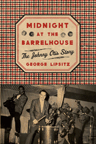

“Johnny Otis—he’s the coolest! A true pioneer of the music I love.”—Aaron Neville


“We are lucky to have Johnny Otis, as the world is short on smart, soulful, funny, gifted, walk-the-walk folk. Bless his heart.”—Joan Baez
“Johnny Otis is one of the most important figures in the history of R&B and rock and roll.”—Bonnie Raitt
“Johnny’s career just dazzles the mind. From discovering Esther Phillips and Jackie Wilson, to being a drummer, singer, piano player, bandleader, hit-maker right down to sculpting and painting. He even lost a seat for the California state assembly. You can’t top that. Willie and the Hand Jive indeed.”—Bob Dylan
“A story that needs to be read and appreciated.” —Choice